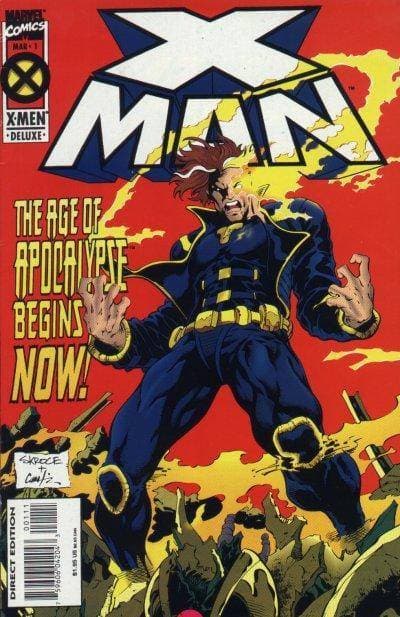
X-Man
Nathaniel Grey
First Appearance
X-Man #1 (1995)
Powers & Abilities
Teams
Also Known As
Nate Grey, Nathan Grey, Shaman of the Mutant Tribe, 19X, Washington Square's Golden Boy, Washington Square Miracle Worker, Second Coming, Nate the Great, Self/friend Nate, Nate Summers, Nathaniel Grey
About X-Man
Nathaniel Grey — better known as Nate Grey or X-Man — is one of Marvel's most cosmically powerful mutants, a psionic force of nature born not through natural lineage but through the genetic engineering of the villainous Mister Sinister in the alternate dystopian reality known as the Age of Apocalypse. Crafted from the DNA of Scott Summers and Jean Grey, Nate was designed to be the ultimate weapon, but he broke free of that destiny and became something far more unpredictable. His debut in X-Man #1 (1995) marked a watershed moment for the Age of Apocalypse crossover event, and that first issue remains a cornerstone key for collectors hunting complete AOA runs.
After the Age of Apocalypse collapsed, Nate found himself stranded in the mainstream Marvel universe — a fish out of water carrying power levels that rivaled, and by some accounts exceeded, the combined might of the X-Men. His solo ongoing series explored what it meant to wield near-limitless psionic ability without the grounding of teammates, mentors, or a home reality. Story arcs involving his clashes with Madelyne Pryor, his complicated relationship with the mysterious Selene, and his eventual brush with the cosmic entity known as the Psi-Ops gave the series a dark, philosophical edge that stood apart from the broader X-Men line of the era.
Nate's story took dramatic turns across the decades — he seemingly sacrificed himself to scatter his consciousness across humanity, only to return transformed and radicalized in the Uncanny X-Men run beginning in 2018. In that arc, written by Matthew Rosenberg and Ed Brisson among others, Nate re-emerged as a utopian idealist willing to remake the world by force, becoming a central threat in the Disassembled storyline that effectively closed out one era of X-Men history and paved the way for the Krakoa age. His role as the antagonist of that pivotal arc makes those issues increasingly sought after by collectors who track the connective tissue of modern X-Men continuity.
For collectors, Nate Grey represents a rare combination: a character with a clearly defined first appearance tied to one of Marvel's most celebrated alternate-reality events, a solo title that ran long enough to develop a dedicated cult following, and a recent resurgence that ties him directly to the architecture of contemporary X-Men lore. X-Man #1 and the full Age of Apocalypse tie-in issues are perennial targets, while his appearances in late-era Uncanny X-Men and the Horsemen of Salvation storyline offer more accessible entry points at prices that still have room to grow.