Deathlok
Unit L17
First Appearance
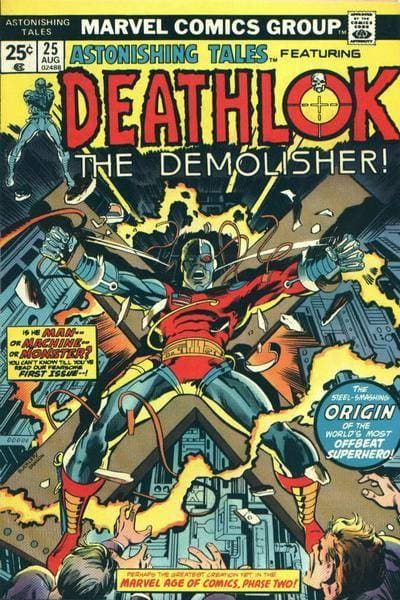
Astonishing Tales #25 (1974)
Powers & Abilities
Teams
Also Known As
Luther Manning, Michael Collins, The Demolisher, John Kelly, Jack Truman, Larry Young, Mike Travers, Robert Saunders, Pacifist, Cybernetics Expert, Chromedome, Monster, Sir, Cybertek's Killing Machine, Kelly, Captain America, Deathlok Prime, Mike Peterson, Michael Peterson, Deathsquawk
About Deathlok
Deathlok stands as one of Marvel's most enduring and complex cyborg characters, first unleashed on collectors in Astonishing Tales #25 (1974) — a landmark issue that introduced the shattered world of Luther Manning, a soldier resurrected as a killing machine in a dystopian future. Created by Rich Buckler, that debut issue is a cornerstone bronze age key that any serious Marvel collector should have on their radar. The concept was raw, gritty, and decades ahead of its time, blending post-apocalyptic science fiction with superhero action in a way that felt genuinely unsettling and unique on the stands.
What makes Deathlok so compelling to collectors is the legacy nature of the identity itself. Over the decades, multiple individuals have worn the Deathlok designation — from Luther Manning to Michael Collins, Jack Truman, and even a version tied to the Marvel Cinematic Universe through Mike Peterson. Each iteration brought new creative teams and fresh story arcs, meaning there are significant keys scattered across multiple eras of Marvel history. Michael Collins' run in the early 1990s solo series gave the character a pacifist heart trapped inside a weapon, generating some of the most thought-provoking storytelling the character has seen. His appearances across X-Force and S.H.I.E.L.D.-connected titles also make him a key figure in some of Marvel's most collectible team books.
Deathlok has intersected with nearly every corner of the Marvel Universe — running with the Avengers, tangling with the Defenders, operating through S.H.I.E.L.D., and even appearing in the pages of X-Force under Rick Remender's celebrated run, which introduced a new generation of readers to the Deathlok concept through a modern lens. His ties to shadowy organizations like Roxxon and the Nth Command give him a conspiratorial edge that keeps writers returning to the character whenever Marvel wants to explore the darker, more militarized side of its universe.
For collectors, Deathlok represents exceptional value across multiple collecting strategies. Astonishing Tales #25 is the foundational bronze age key, but the 1990 limited series, the subsequent ongoing, and his appearances in high-demand team books like X-Force all offer entry points at various price levels. With the character's MCU exposure through Agents of S.H.I.E.L.D. having introduced him to a wider audience, interest in his print appearances has only grown. Whether you are chasing bronze age keys, 90s deep cuts, or modern era appearances, Deathlok's long publication history makes his books a rewarding and endlessly interesting corner of the Marvel back issue market.