Anti-Monitor
Mobius
First Appearance
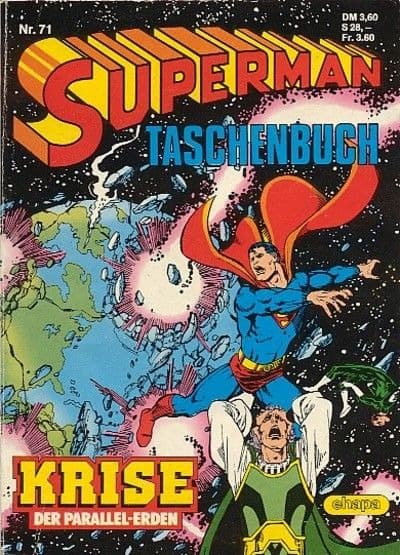
Superman Taschenbuch #71 (1985)
Powers & Abilities
Teams
Also Known As
Monty, Mobius, Anti-God, The Destroyer
About Anti-Monitor
The Anti-Monitor stands as one of the most catastrophically powerful villains in all of comics — a being of near-infinite destructive capacity whose very existence threatened to unmake every reality in the DC Multiverse. Born as Mobius on the antimatter world of Qward, he is the dark mirror counterpart to the Monitor, and his hunger for antimatter energy and universal annihilation has driven some of the most consequential storylines in DC history. Few characters can claim to have literally destroyed entire universes, but the Anti-Monitor reshaped the very foundation of DC continuity in ways that collectors still track, debate, and hunt down original issues to this day.
The Anti-Monitor's landmark debut came in the pages of Crisis on Infinite Earths, the 1985 DC limited series that stands as one of the most important and collectible events in the history of the medium. Written by Marv Wolfman with iconic art by George Pérez, this twelve-issue series saw the Anti-Monitor wage war across infinite parallel Earths, wiping entire universes from existence and culminating in the deaths of major heroes including Supergirl and Barry Allen, the Silver Age Flash. The series was a watershed moment — DC used it to streamline their multiverse into a single continuity, and the Anti-Monitor was the engine of that seismic transformation. Collectors prize original issues of this run, particularly the early chapters where the villain is first revealed in his terrifying full form.
The Anti-Monitor's reach extended well beyond Crisis. He resurfaced as a central figure in the Sinestro Corps War, lending his immense power to Sinestro's yellow ring army and once again threatening universal destruction. His connection to the Black Lantern Corps during Blackest Night further cemented his role as a recurring apocalyptic force in the DC Universe, while his ties to the New Gods mythology and the concept of Mobius Chair added layers of cosmic significance to his lore. Each major reappearance tends to carry serious story weight, making his appearances reliable signposts for landmark DC storytelling.
For collectors, the Anti-Monitor represents a uniquely high-value target. His first appearance material from 1985 is historically significant — these are books tied directly to one of the most discussed continuity events in comics history. Key issues from Crisis on Infinite Earths remain strong performers in the back-issue market, especially in higher grades. Any series touching on the Sinestro Corps War, Blackest Night, or subsequent multiverse-level events where the Anti-Monitor appears is worth tracking down. If you are building a serious DC collection focused on universe-altering stories and iconic villainy, the Anti-Monitor's key books are essential pieces of the puzzle.