The Mask
n/a
First Appearance
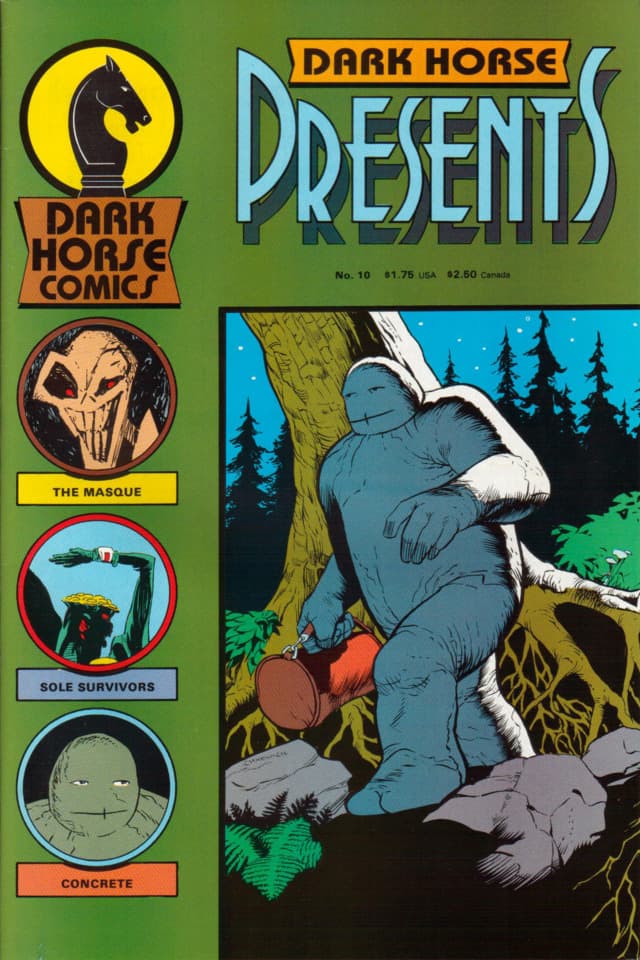
Dark Horse Presents #10 (1987)
Powers & Abilities
Also Known As
Big-Head, The Masque, Lt. Mitch Kellaway, Kathy, Loki, Ben, Rick, Ray Tuttle, Hugo, Archie, Paul Newmen, Snuck, Ira Staub, Aldo Krasker, Lobo, Joker, Eric Martin, The Big-Head Killer, Stanley Ipkiss, Timothy "Tim" Avery, Tim Avery
About The Mask
Few characters in independent comics history have made as chaotic and unforgettable an entrance as The Mask, who first unleashed pandemonium on readers in Dark Horse Presents #10 back in 1987. Created by writer and artist Mike Richardson and developed further by John Arcudi and Doug Mahnke, The Mask is not a hero in any traditional sense — it is a ancient, supernaturally charged artifact that transforms whoever wears it into an unstoppable, reality-bending force of pure id. The wearer becomes virtually omnipotent, wielding a grotesque arsenal of cartoon-logic powers that include shape-shifting, reality manipulation, invulnerability, and the ability to conjure weapons or gadgets from thin air. The result is a character that plays by no rules, answers to no moral code, and exists in a space somewhere between cosmic horror and pitch-black comedy.
The original arc introduced Stanley Ipkiss, a down-on-his-luck everyman whose life transforms catastrophically the moment he slips on the ancient wooden mask. Unlike the lighthearted film adaptation that would follow years later, the Dark Horse comics version of The Mask is genuinely dangerous and deeply unsettling. Ipkiss uses his newfound power for violent, gory revenge, and the stories surrounding him carry a mean-spirited edge that collectors of mature, creator-driven comics absolutely love. What makes the mythology even richer is that the mask does not belong to any single person — it passes from host to host across multiple story arcs, including stints worn by detective Kellaway, a child named Tim Avery, and even a dog named Milo, with each new wearer offering a fresh perspective on the artifact's terrifying power.
For collectors, the key books are well established. Dark Horse Presents #10 is the holy grail — the true first appearance of the mask and its concept, and a book that continues to climb in value as awareness of the character's comic origins grows. The original limited series from 1991 and its numerous follow-up miniseries, including The Mask Returns, The Mask Strikes Back, and the wild crossover The Mask vs. The Joker, are all highly sought after. Doug Mahnke's artwork across these series is ferocious and kinetic, and his pages are among the most dynamic in Dark Horse's entire catalog.
The Mask represents exactly the kind of independent comic treasure that savvy collectors seek out — a character with genuine creative ambition, a distinct visual identity, and a publishing history that rewards deep diving. With a sprawling cast of alias-holders, a mythology that spans decades of Dark Horse output, and a first appearance that predates mainstream recognition by years, building a complete Mask run is a rewarding challenge. These books are undervalued relative to their historical importance and cultural footprint, making now an ideal time to chase down the key issues before the market catches up.